About AfriAlliance
AfriAlliance is a five year project funded by the European Union’s Ho-
rizon 2020 research and innovation programme.
AfriAlliance facilitates the
collaboration of African and European stakeholders in the areas of water
and climate innovation, research, policy and capacity development by sup-
porting knowledge sharing and technology transfer.
Rather than creating new networks,
the 16 European and African
partners in this project consolidate existing ones. The ultimate objective is
to strengthen African preparedness for future climate change challenges.
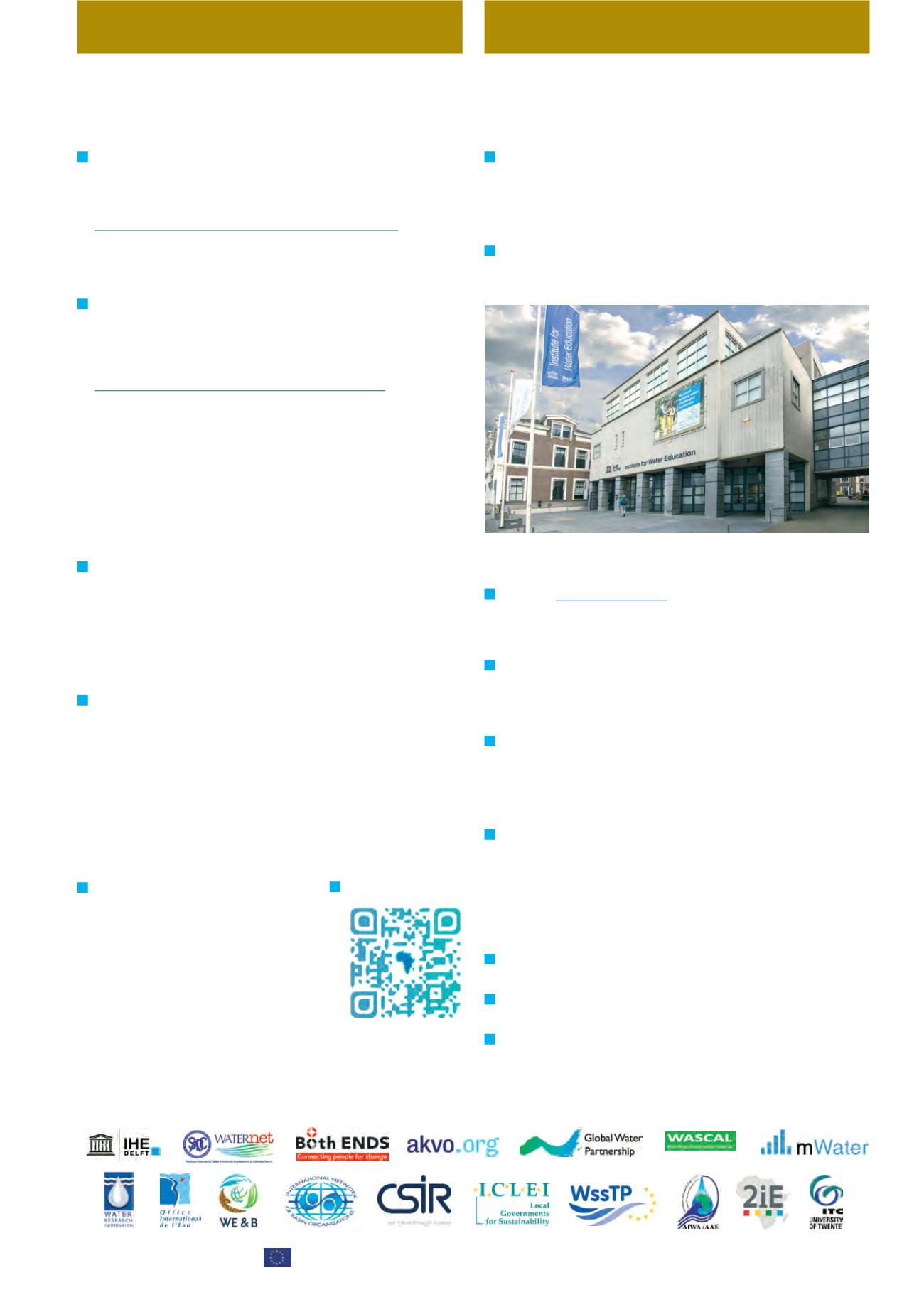
AfriAlliance is led by the IHE Delft Institute for Water Education (Project
Director: Dr. UtaWehn) and runs from 2016 to 2021.
Website :
AfriAlliance activities
Africa-EU cooperation is taken to a practical level by identifying (non-)
technological innovation and solutions
for local needs and challenges.
AfriAlliance also identifies constraints and develops strategic advice for
improving collaborationwithinAfrica and betweenAfrica and the EU.
To help improvewater and climateMonitoring& Forecasting inAfrica,
AfriAlliance is developping a triple sensor approach, whereby water and
climate data from three independent sources are geo-spatially collocated:
space-based (satellites), in-situ hydro-meteorological station observation
networks and data collected by citizens.
Sharing of knowledge is facilitated
through a series of events and
through an innovative online platform. Demand-driven AfriAlliance ‘Ac-
tion Groups’ bring together African and European peers with relevant
knowledge and expertise towork jointly towards solutions.
Realisation
Authors:
Natacha Amorsi, Sonia Siauve (Office International de l’Eau),
UtaWehn, AngelesMendoza-Sammet (IHEDelft).
Contributors:
Jean-Marie Kileshye Onema (Waternet), Andrea Rubini
(WssTP), DavidSmith (WE&B),Mamohloding Tihagale (WRC).
GraphicDesign:
GillesPapon (Office International de l’Eau).
AFRIALLIANCEHASRECEIVED FUNDING FROM THE EUROPEANUNION’SHORIZON 2020
RESEARCHAND INNOVATIONPROGRAMMEUNDERGRANTAGREEMENTNO 689162
References
DESCRIPTION
[a]
UNEP (2013), Africa Environment Outlook 3: summary for Policy Ma-
kers, UnitedNations Environment Programme (UNEP). Nairobi, Kenya.
[b]
[c]
UNEP. (2010). “AfricaWater Atlas”. Division of EarlyWarning and As-
sessment (DEWA). United Nations Environment Programme (UNEP). Nai-
robi, Kenya.
TECHNICALSOLUTIONS
[d]
V. Somerset, C Van der Horst, B Silwana and C. Walters, (2012), De-
velopment of analytical sensors for the identification and quantification of
metals in environmental samples,WRCReport No. 2013/1/12.
[e]
[f]
PMarkGraham, ChrisWSDickens&RJimTaylor (2010),miniSASS -A
novel technique for community participation in river healthmonitoring and
management, pages25-35, publishedonline: 07 Jan2010, African Journal
of AquaticScience, Volume 29, 2004 - Issue 1.
[g]
Marlene van der Merwe-Botha & Leonardo, Wastewater Risk Abate-
ment Plan - AW2RAP GUIDELINE To plan andmanage towards safe and
complyingmunicipal wastewater collection and treatment in South Africa,
(2011),WRCReport No. TT 489/11.
GOVERNANCESTRUCTURE
[h]
Lautze J., de Silva S., GiordanoM., Sanford L., (2011), Putting the cart
before the horse:Water governance and IWRM, Natural Resources Forum,
35, 1-8.
[i]
Wehn, U. (2017) Digital transformations and the governance of human
societies, presentation at EC Joint ResearchCentre, ISPRA, Italy, 7April.
CAPACITYDEVELOPMENT
[j]
Vallejo B. and Wehn U. (2016) Capacity Development Evaluation: The
Challenge of the Results Agenda andMeasuring Return on Investment in
Capacity Development in the Global South, World Development, Vol. 79,
pp.1-13, doi:10.1016/j.worlddev.2015.10.044.
[k]
WehnU. (2015)TheGlobalContent:NationalCapacityDevelopmentStrate-
gies, Tailor Made Training for contact points of Uganda’s National Water and
EnvironmentCapacityDevelopmentStrategy, incollaborationwith theMinistry
forWater andEnvironment (Uganda), Kampala,Uganda, 10-11November.
LISTOFACRONYMS
•
CD: Capacity development.
•
EIA: Environmental Impact Assessment.
•
EMS: EnvironmentalManagement Systems.
•
SIF: Social Innovation Factsheet.
•
TRL: TechnologyReadiness Levels.
MORE INFORMATION
Further reading
Presentationof


